Overland Park sits on a complex mix of residual clays and shale-derived soils that react dramatically to seasonal moisture swings. The hot, humid summers and dry, cold winters typical of Johnson County create an annual cycle of swelling and shrinkage that can crack lightly-loaded slabs and pavements. In our lab, the Atterberg limits test is the first line of defense against these problems. By quantifying the liquid and plastic limits of a soil, we define the moisture range where the material behaves plastically—information that directly feeds into the expansive soil classification required by IBC Section 1803. A single set of grain-size analysis combined with Atterberg limits often reveals whether a site’s clay fraction is high enough to warrant special foundation measures before the first yard of concrete is poured. For any project east of US-69, where the underlying shale weathers into a sticky, high-plasticity clay, this test is not just a checkbox; it is the basis for rational foundation design.
The plasticity index is not just a number on a report—it is the single best predictor of shrink-swell behavior in the residual clays of Johnson County.
Methodology and scope
Local considerations
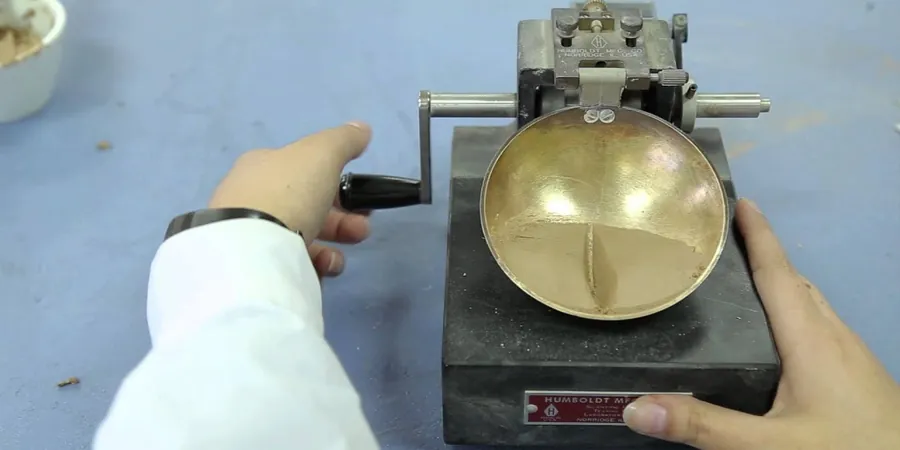
A standard Casagrande cup sits on our lab bench, its brass bowl and grooving tool ready for the next sample. The procedure looks simple—drop the cup, count the blows, carve the groove—but the interpretation is what separates a reliable report from a misleading one. Overland Park soils with a liquid limit above 50 and a plasticity index exceeding 30 are classified as fat clays (CH) under the Unified System. These materials, common in the weathered shale zones west of Metcalf Avenue, can generate swell pressures above 1,000 psf when wetted. If a structural engineer designs a slab-on-grade assuming a PI of 15 and the actual value is 35, the differential movement can shear partition walls and rupture plumbing lines. That is why we run two-point and three-point liquid limit determinations to verify consistency, and why we reject any cup drop count outside the 15-35 blow range without a second run. The cost of an inaccurate Atterberg limit is a foundation that moves, and in a city with over 190,000 residents, that risk plays out in dozens of homes every year.
Applicable standards
ASTM D4318-17e1 (Standard Test Methods for Liquid Limit, Plastic Limit, and Plasticity Index of Soils), ASTM D2487-17e1 (Unified Soil Classification System), IBC 2018 Section 1803 (Geotechnical Investigations)
Associated technical services
Atterberg Limits Determination
Full liquid limit, plastic limit, and plasticity index testing per ASTM D4318. We prepare samples from disturbed bulk material, run multi-point LL determinations, and report PI, LI, and USCS classification in a stamped lab report.
Expansive Soil Screening
Combined Atterberg limits and percent passing No. 200 sieve to classify expansion potential per Holtz and Gibbs criteria. We flag high-PI clays that require moisture-controlled excavation or engineered fill replacement before slab construction.
Typical parameters
Frequently asked questions
How much does Atterberg limits testing cost in Overland Park?
A standard Atterberg limits test (liquid limit and plastic limit) on a single sample typically runs between US$50 and US$110, depending on whether we also determine the natural moisture content and perform the full gradation. Multiple samples from the same boring reduce the per-sample rate.
Why do my Overland Park soil report need Atterberg limits if I already have a boring log?
A boring log gives you a visual-manual description, but Atterberg limits quantify the plasticity that causes shrink-swell. In Johnson County, two clays that look identical can have plasticity indices of 10 and 35—the difference between a stable slab and one that requires structural reinforcement. The IBC requires classification based on laboratory testing, not field estimates alone.
How long does it take to get Atterberg limits results back from the lab?
Typical turnaround is two to three working days from the time the sample arrives at our lab. We can accommodate rush requests for an additional fee if the sample is received before noon and the report is needed for a same-week foundation pour.
What makes the plastic limit different from the liquid limit?
The liquid limit is the moisture content where the soil transitions from a plastic to a liquid state, measured using the Casagrande cup. The plastic limit is the moisture content where the soil crumbles when rolled into a 3.2 mm thread. The difference between them—the plasticity index—defines the moisture range where the soil behaves as a moldable solid, and that range directly correlates with expansion potential.