Overland Park shifted from a streetcar suburb into a major employment hub in Johnson County, and with that growth came a wave of mid-rise commercial buildings and dense residential clusters along corridors like College Boulevard and Metcalf Avenue. What often escapes early-stage planning is how the loose alluvial silts and sands buried beneath the floodplain terraces of Indian Creek and the Blue River can respond during the long-period shaking that reaches eastern Kansas from the New Madrid Seismic Zone. Our soil liquefaction analysis examines the susceptibility of these saturated granular layers to sudden strength loss, because even a magnitude 6.5 event centered 300 miles away can generate enough cyclic strain to trigger pore-pressure buildup in poorly consolidated deposits. We combine field penetration data—especially from spt-drilling campaigns that recover split-spoon samples at close vertical intervals—with laboratory index testing to build a defensible site-specific model, rather than relying on generalized county-level hazard maps.
Liquefaction in Overland Park is not about the big one hitting Kansas City—it is about long-period amplification in loose creek-terrace sands that can settle and shift even under moderate shaking.
Methodology and scope
Local considerations
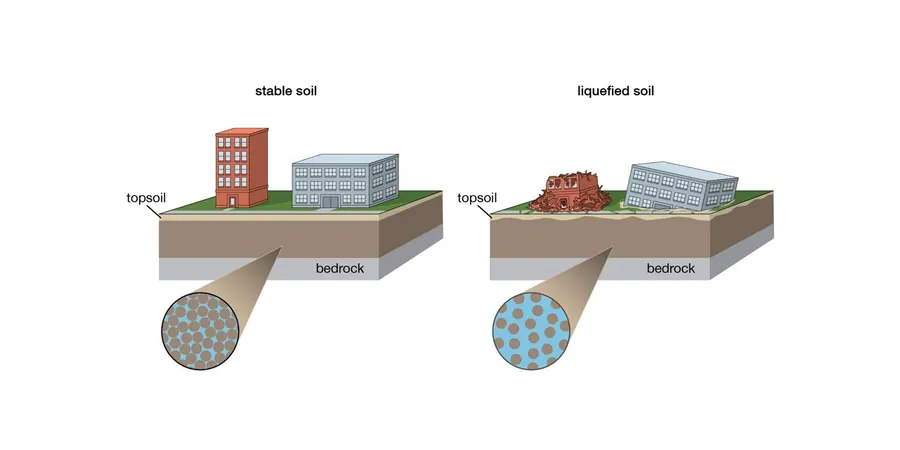
A developer we worked with on a five-story mixed-use building off 135th Street had already poured the mat foundation when a peer review flagged the absence of a liquefaction screening. The site sat on ten feet of clean sand that had been compacted during grading, but borings revealed a second, unimproved sand layer between 18 and 25 feet that was loose and fully saturated. Our analysis showed that under the design earthquake—a 2,475-year return event per IBC—the factor of safety against triggering dropped below 0.9. That meant the lower sand could liquefy while the overlying crust remained intact, a condition that often produces differential settlement severe enough to shear plumbing risers and crack elevator cores. We modeled post-liquefaction volumetric strain and estimated up to three inches of total settlement concentrated within a twenty-foot zone. The fix involved targeted stone-columns installed through the mat openings, which drained excess pore pressure and densified the problem layer before interior framing began.
Applicable standards
IBC Section 1803.5.12 (seismic site class and liquefaction assessment), ASCE 7-16 Chapter 20 (site-specific ground motion procedures), ASTM D1586-18 (standard penetration test and split-barrel sampling), ASTM D2487-17 (soil classification for engineering purposes), Youd & Idriss (2001) NCEER/NSF workshop recommendations for SPT-based liquefaction triggering
Associated technical services
SPT-based liquefaction triggering
We execute closely spaced SPT borings, correct raw N-values for energy ratio, overburden pressure, and fines content, then compute the factor of safety against liquefaction at each depth interval using the Seed-Idriss simplified procedure as updated by the NCEER workshops.
CPT-based continuous profiling
For sites with highly stratified sands and silts, we deploy electric cone penetration testing to capture a millimeter-scale record of tip resistance and pore pressure, applying the Robertson (2009) soil behavior type method for liquefaction susceptibility.
Post-liquefaction settlement and lateral spread analysis
Beyond the triggering check, we quantify expected ground deformation using empirical models from Ishihara & Yoshimine (settlement) and Youd et al. (lateral spread), providing the structural engineer with displacement parameters for performance-based design.
Typical parameters
Frequently asked questions
What triggers a liquefaction study requirement in Overland Park?
The IBC mandates a liquefaction assessment for sites assigned to Seismic Design Category C or higher where the groundwater table is within 50 feet of grade and the subsurface contains sands with SPT blow counts below 15. In Overland Park, this typically applies to larger commercial projects and essential facilities along the creek valleys, not to single-family homes on the upland glacial till.
How much does a soil liquefaction analysis cost for a typical commercial lot?
For a standard commercial parcel in Overland Park requiring two to three SPT borings with laboratory testing and a signed report, the fee ranges from US$2,700 to US$4,300 depending on depth to refusal and the number of samples that need cyclic triaxial or index testing.
Can you evaluate liquefaction risk without drilling new borings?
If existing geotechnical logs from the site or adjacent parcels are available and include SPT N-values, groundwater observations, and soil descriptions per ASTM D2487, we can perform a desktop screening. However, most lenders and city reviewers in Johnson County require site-specific data less than five years old because water table levels and fill placement can change the susceptibility significantly.
What ground improvement options do you recommend if the factor of safety is too low?
The appropriate method depends on the depth and thickness of the liquefiable layer. For shallow sands within 20 feet, we often specify vibrocompaction or stone columns to densify and create drainage paths. Deeper deposits may require compaction grouting or, in extreme cases, deep foundations that bypass the problem stratum entirely. We evaluate each option against the project’s settlement tolerance and construction schedule.