Seismic assessment in Overland Park addresses the subtle but real earthquake hazard linked to the Nemaha Ridge and Humboldt Fault Zone, requiring compliance with IBC 2021 and ASCE 7-22 provisions for Seismic Design Category B to C. Our approach integrates soil liquefaction analysis to evaluate saturated alluvial silts along the Blue River and Indian Creek, where cyclic softening could compromise shallow foundations. For critical structures, base isolation seismic design provides enhanced performance by decoupling the superstructure from ground motion.
This category supports mid‑rise commercial towers, healthcare facilities, and essential infrastructure where uninterrupted post‑event function is mandatory. A seismic microzonation study refines site‑specific response spectra across variable Pennsylvanian limestone and shale profiles, directly informing foundation‑level acceleration demands and structural ductility requirements.
In Overland Park, the difference between a 100-kip and a 200-kip anchor capacity often lies in how the grout was placed in the Chanute shale—not in the steel.
Methodology and scope
Local considerations
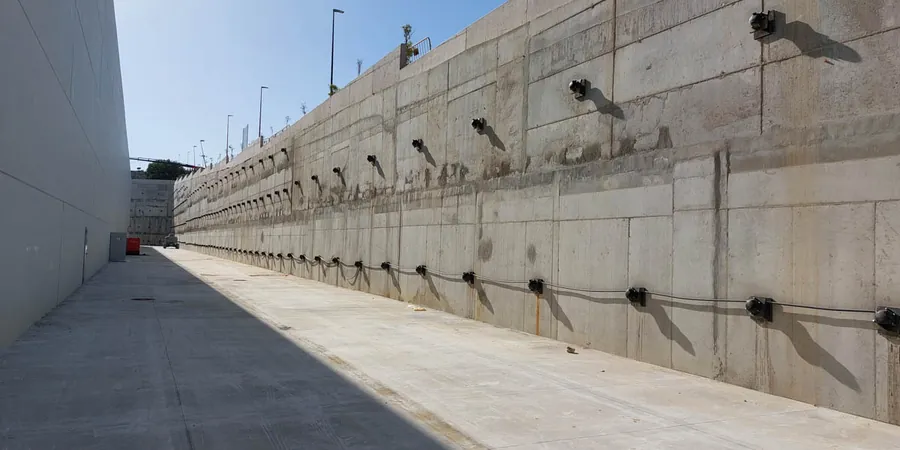
In Overland Park, many commercial excavations hit the contact between the Argentine limestone and the underlying Chanute shale sooner than the boring logs suggest—the contact undulates, and a three-foot difference puts the bond zone in a much weaker material. When that happens, a passive nail designed for rock suddenly behaves like a soil nail with half the pullout resistance. The other chronic issue is stress corrosion cracking in permanent tiebacks where groundwater sulfate levels exceed 500 ppm; the Pennsylvanian shales in Johnson County can produce sulfate concentrations above 1,000 ppm, so Type V cement grout becomes mandatory. The team specifies encapsulated tendons with corrugated HDPE sheathing and end-plate details that allow lift-off testing five years after construction without breaking the waterproofing seal.
Explanatory video
Applicable standards
IBC 2024 Chapter 18 (Soils and Foundations, anchored systems), FHWA-RT-96-029 (Ground Anchors and Anchored Systems), PTI DC35.1-20 (Recommendations for Prestressed Rock and Soil Anchors), AASHTO LRFD Bridge Design Specifications 10th Ed., Section 11, ASTM A416 / A722 (tendon material specifications)
Associated technical services
Active tieback design
Prestressed anchors for soldier pile and secant pile walls. Design includes load determination, unbonded length per AASHTO, and lock-off load specification.
Passive soil nail design
Grouted bars for top-down excavation support in residual soils and weathered rock. Pullout capacity verified with field nail tests before production drilling.
Corrosion protection systems
PTI Class I and II encapsulation details for permanent anchors in sulfate-rich shale. Double-corrugated HDPE sheathing, factory-grouted tendons, and end-cap seals.
Anchor load testing and monitoring
Performance, proof, and extended creep tests per FHWA. Lift-off testing and load cell monitoring for critical permanent anchors with remote data access.
Typical parameters
Frequently asked questions
What’s the difference between an active anchor and a passive nail for a retaining wall in Overland Park?
An active anchor is tensioned after grouting to apply a predetermined load to the wall, controlling movement from the start. A passive nail only mobilizes resistance as the ground deforms. In Overland Park, active anchors are preferred for cuts deeper than 15 feet or when adjacent structures cannot tolerate settlement, while passive nails work well for shallower cuts in competent limestone where some deformation is acceptable.
How much does anchor design and testing cost for a typical project?
For a standard design package covering one wall with five to fifteen anchors—including load determination, corrosion protection detailing, and on-site proof testing—the range is US$1,090 to US$3,790. The final figure depends on anchor depth, whether the bond zone is in limestone or shale, and the number of performance tests required by the building official.
What load tests are required on production anchors in Johnson County?
Per IBC 1810.3.12 and PTI DC35.1, every production anchor undergoes a proof test to 133% of the design load. Additionally, performance tests with extended creep monitoring are required on at least 5% of anchors. In the Chanute shale, the creep test is the real acceptance criterion—if movement exceeds 0.04 inches per log cycle of time, the anchor is rejected regardless of the proof test result. More info.