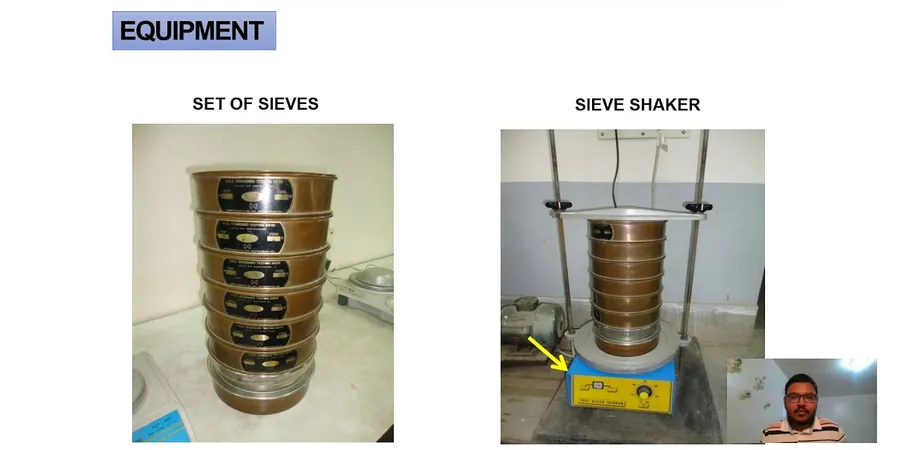
The mechanical sieve shaker sets up in our Overland Park lab, loaded with a stack of ASTM E11 sieves ranging from coarse gravel down to the No. 200 mesh. For the fine fraction passing that last sieve, the hydrometer cylinder comes next—a graduated glass column where soil settles in suspension, and we take timed readings at 40 seconds, 2 minutes, 5 minutes, 15 minutes, and beyond. This isn’t a one-test-fits-all exercise. Overland Park’s stratigraphy runs from fat clays in the alluvial deposits near Indian Creek to lean silty sands across the upland loess-mantled terrain, so the combined sieve-and-hydrometer approach lets us build a full 0.001 mm to 75 mm particle-size distribution. For pavement subgrades in the Blue Valley area we routinely pair this with a CBR test for road design to tie gradation directly to bearing capacity, and when the fines plot high-plasticity we run Atterberg limits on the split sample before the hydrometer even starts, because knowing the clay mineral behavior in Overland Park’s wet-dry cycles changes how you read the sedimentation curve.
A full grain-size curve doesn’t just classify the soil—it predicts how water will move through it, and that’s the decision-maker for Overland Park’s tight clay subgrades.
Methodology and scope
The sieve stack covers 75 mm down to 0.075 mm using mechanical shaking for 10 to 15 minutes per ASTM C136, while the hydrometer side follows ASTM D7928 with a 152H hydrometer calibrated at 20°C. For Overland Park’s residual clays we extend the sedimentation readings out to 24 hours when the curve needs resolution below 0.002 mm, especially on projects where the fill-compaction specification references a percent-fines threshold for moisture conditioning. The lab runs a quality-control duplicate every tenth sample, and the hydrometer cylinder temperature is logged at each reading interval to apply the composite correction. When we see a bimodal distribution in the loess-derived silts—coarse silt from the windblown fraction plus a fine-clay tail from post-depositional weathering—the curve shape alone tells the project engineer whether to expect frost-susceptible behavior or drainage problems under the typical Overland Park freeze-thaw cycle.
Local considerations
A few years back we got called out to a multi-family site off 135th Street where the grading plan had been designed around a borrow-source gradation that looked fine on paper—mostly silty sand with less than 12% fines. When the earthwork contractor opened the cut, the material ran closer to 35% passing the No. 200, and the plasticity was high enough to turn the fill lifts into a grease-slick after one moderate rain. The grain-size analysis we ran that week—full sieve stack plus hydrometer—showed a clay fraction of 18% that the preliminary probe hadn’t caught because the original testing stopped at a wash-sieve without the sedimentation leg. The developer lost three weeks re-engineering the subgrade drainage and importing select fill. That’s the risk in Overland Park: the upland loess can look sandy in a hand-auger sample, but the hydrometer reveals a fines tail that changes the compaction curve, the permeability, and the frost-susceptibility classification. Skipping the combined analysis on clay-rich alluvium or loess-derived silts means betting the foundation drain design on a guess about percent clay, and the guess loses when Johnson County gets a wet spring.
Applicable standards
ASTM C136 – Sieve analysis of fine and coarse aggregates, ASTM D7928 – Hydrometer analysis of fine-grained soils, ASTM D2487 – USCS classification based on particle-size distribution and Atterberg limits
Associated technical services
Full Sieve Analysis (ASTM C136)
Mechanical sieving from 75 mm to No. 200 with washed fines determination, reported as percent retained per sieve and cumulative passing curve.
Hydrometer Sedimentation (ASTM D7928)
Timed-density readings with temperature and meniscus corrections, yielding the silt-clay distribution below 0.075 mm down to approximately 0.001 mm.
Combined Grain-Size Report
Single log-plot curve merging sieve and hydrometer data, plus calculated Cu, Cc, and USCS group symbol per ASTM D2487.
Correlative Atterberg Limits
Liquid and plastic limit on the minus-40 fraction to confirm USCS classification and flag expansive-clay risk for Overland Park’s high-PI loess deposits.
Typical parameters
Frequently asked questions
How much does a combined sieve and hydrometer analysis cost in Overland Park?
For a single sample with full sieve stack plus hydrometer, the cost typically runs between US$100 and US$190 depending on whether Atterberg limits are bundled in the same report. Turnaround is usually three to four business days from sample receipt.
When does ASTM require a hydrometer analysis instead of just a sieve?
Any time more than 12% of the sample passes the No. 200 sieve, ASTM D2487 and D7928 both point toward hydrometer testing for the fine fraction. In Overland Park’s loess and alluvial clays that threshold is exceeded on most sites, so skipping it leaves the USCS classification incomplete.
What sample mass do you need for the full grain-size test?
For predominantly fine-grained soils we need about 200 to 500 grams of material. If the soil contains gravel-sized particles, we ask for up to 5 kilograms so the coarse fraction is statistically representative per ASTM C136.
Can the hydrometer curve detect expansive clays in Overland Park?
The grain-size curve alone tells you the clay fraction percentage but not the clay mineralogy. That’s why we pair it with Atterberg limits—when the hydrometer shows greater than 20% clay and the liquid limit is above 50, the combination signals potentially expansive behavior that matters for Overland Park’s slab-on-grade foundations.
How long does the sedimentation phase of the test run?
Standard practice per ASTM D7928 takes readings at 0.5, 1, 2, 5, 15, 30, 60, 240, and 1440 minutes. For Overland Park clays that suspend fine colloids we often extend the final reading to 24 hours to define the tail of the curve below 0.002 mm.