We recently reviewed a proposed mid-rise office complex near College Boulevard where the initial geotech report glossed over the site class. Overland Park sits on interbedded Pennsylvanian shales and limestones, but the weathering profile can swing Vs30 values more than you'd expect just looking at a state map. The IBC requires a site-specific seismic microzonation when a default Class D assumption won't cut it, especially once the building exceeds three stories. Running an MASW survey across the footprint gave us the true shear-wave profile and confirmed a site class C boundary, which tightened the seismic base shear by nearly 12% compared to the conservative default. That single step saved the structural team a pile of unnecessary steel.
In Overland Park, a site-specific Vs30 measurement often upgrades the site class from D to C, directly reducing seismic design forces.
Methodology and scope
Local considerations
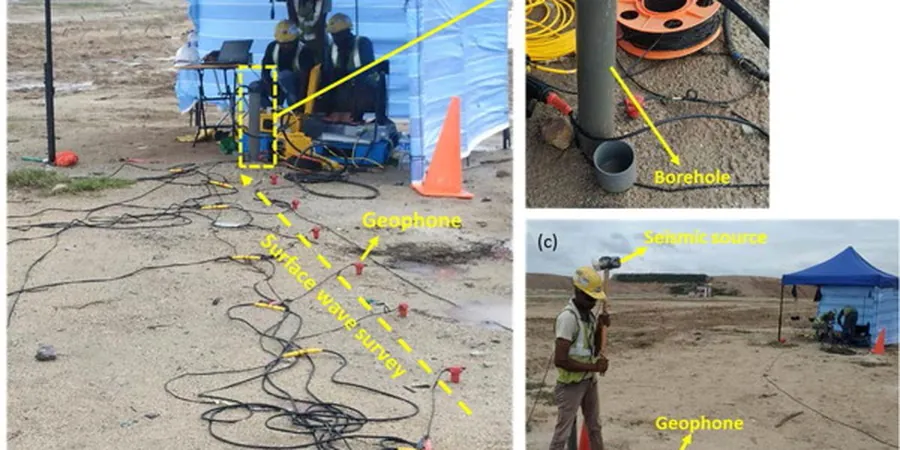
The field spread for an active MASW line is straightforward—a 24-channel seismograph, 4.5 Hz geophones, and a sledgehammer source—but the real risk is in the interpretation when you ignore the thin limestone stringers common in the Kansas City Group. A high-velocity caprock just a few feet thick can fool an automatic inversion into assigning a stiffer site class than the underlying weathered shale actually provides. We cross-check every seismic microzonation with at least one borehole to confirm refusal depth and rock quality designation. Skipping that step is how you end up with a structural model that underestimates short-period amplification, and nobody wants to explain that to the EOR after the shop drawings are out.
Applicable standards
ASTM D4428/D4428M-14 (crosshole seismic), ASCE 7-22 Chapter 20 (site classification), IBC 2021 Section 1613 (earthquake loads), ASTM D7400-19 (downhole seismic), NEHRP Recommended Provisions (site response)
Associated technical services
Site-Specific Vs30 Profiling
Active MASW or downhole seismic testing to measure shear-wave velocity directly. We provide the Vs30 value, site class per ASCE 7, and response spectra for use in the structural analysis.
Development-Scale Microzonation
For planned communities or corporate campuses, we grid the site with surface wave lines and boreholes, producing a GIS-ready zonation map that identifies boundaries between site classes and liquefaction-susceptible units.
Typical parameters
Frequently asked questions
How much does a seismic microzonation study cost for a single building site in Overland Park?
For a typical commercial lot, seismic microzonation runs between US$3.580 and US$8.200 depending on the number of MASW lines and whether we need to mobilize a drill rig for calibration boreholes. A larger campus-scale study with multiple cross-sections and a full GIS deliverable can range from US$9.500 to US$17.170.
Does the City of Overland Park require site-specific seismic classification?
Overland Park follows the IBC, which requires site-specific classification when Site Class F conditions are suspected or when the default Site Class D is not conservative enough for the structure. The building official may also request it for essential facilities like fire stations or hospitals.
What is the difference between MASW and downhole seismic for microzonation?
MASW uses a surface array of geophones and a sledgehammer source to generate a Rayleigh-wave dispersion curve, giving a 1D Vs profile averaged over the array length. Downhole seismic places a receiver in a borehole and measures travel time directly from a surface source, offering better resolution at depth but requiring a cased borehole. We often run both when the stratigraphy is complex.
How does the local geology affect seismic amplification in Overland Park?
The Pennsylvanian-age bedrock here includes alternating shale and limestone layers that create sharp velocity contrasts. Weathered shale can amplify short-period ground motion more than a uniform soft-soil profile would, so a site-specific microzonation captures the impedance boundaries that a generic USGS map smooths over.