The Pennsylvanian-age shale and limestone formations under Overland Park dictate every deep excavation decision we make. Layers of the Kansas City Group alternate between competent limestone ledges and weaker, clay-rich shale seams that lose strength fast when exposed to air or moisture. Groundwater sits shallow across much of Johnson County, typically between 8 and 20 feet, so even a 15-foot basement cut needs a dewatering plan and a lateral support system that accounts for softened shale at the interface. Our lab runs index and shear-strength tests on these units before any shoring design leaves the door. We often pair early-stage borings with test pits to map the exact depth of weathered shale contact, which controls where tiebacks or internal bracing must anchor into sound rock. For cuts deeper than about 18 feet, we integrate slope stability analysis of the adjacent right-of-way to confirm the excavation sequence does not unload a weak interbed.
Shale softening at the limestone contact is the single biggest variable in Overland Park excavation design — we test for it on every project.
Methodology and scope
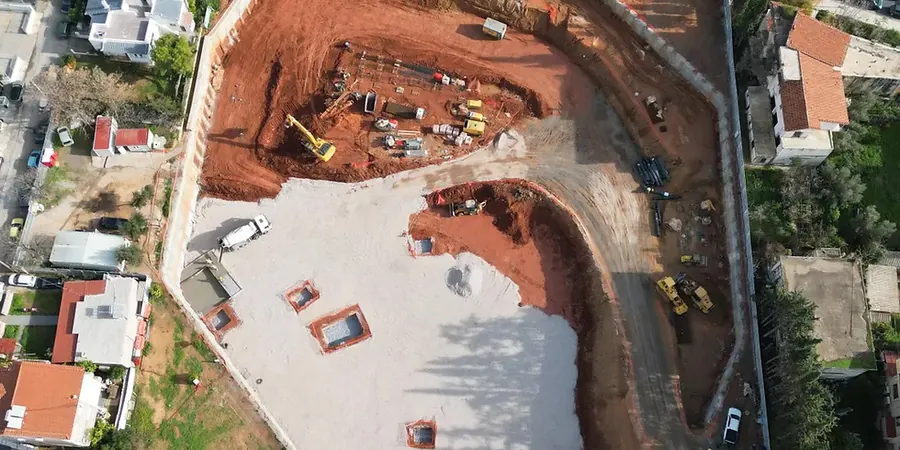
Local considerations
Overland Park has grown fast since the 1990s, so many deep excavations now happen on infill lots between older commercial buildings or within a few feet of active roadways. The city's clay-rich residual soils drain slowly; a heavy rain after a cut is opened can saturate the upper bench and double the lateral load on soldier piles within hours if the slope face is not shotcreted or covered. We have also seen cases where an undocumented water line or storm sewer crosses the site at the exact elevation of a planned tieback row, requiring a fast redesign to move the anchor. Because much of the bedrock here is horizontally bedded, a vertical cut in limestone can spall when the underlying shale weathers and crumbles, undercutting the harder caprock. Our designs include mandatory inspection intervals after every weather event and a clear trigger plan for when measured movement exceeds the pre-set threshold.
Explanatory video
Applicable standards
IBC 2021 Chapter 33 (Safeguards During Construction), ASCE 7-22 Section 12.13 (earth-retaining structures), ASTM D7012-14 (unconfined compressive strength of rock cores), FHWA-NHI-10-024 (Earth Retaining Structures and Ground Anchors), OSHA 1926 Subpart P (Excavations)
Associated technical services
Shoring system analysis and detailing
We size soldier piles, walers, struts, and tiebacks using lateral earth pressures derived from triaxial and direct-shear lab results on site soil and rock.
Dewatering and groundwater control plans
Permeability testing on rock cores and overburden soils feeds a 2D or 3D seepage model that defines wellpoint spacing, pump capacity, and sump placement.
Adjacent structure protection design
We set settlement and vibration limits, design underpinning or compensation grouting if needed, and specify real-time monitoring points on neighboring buildings.
Construction-phase monitoring and threshold response
Includes inclinometer casings behind the wall, optical survey prisms on adjacent facades, and a written action plan tied to deflection and settlement triggers.
Typical parameters
Frequently asked questions
How deep can you design an excavation in Overland Park shale and limestone?
We routinely design cuts from 12 feet to about 45 feet. Deeper excavations are feasible but require more solid rock-anchor systems and longer construction schedules. The practical limit usually comes from right-of-way constraints and the cost of permanent tiebacks that must stay below neighboring foundations.
What is the approximate cost range for a deep excavation design package?
A full geotechnical design package, including lab testing, shoring calculations, dewatering analysis, and monitoring specifications, typically runs between US$2,380 and US$8,060 depending on excavation depth, site access constraints, and the number of adjacent structures needing protection.
Do you handle IBC and OSHA submittals for the excavation plan?
Yes. Our drawings and calculations reference IBC Chapter 33 and OSHA 1926 Subpart P. We provide sealed shoring plans, a dewatering narrative, and a site-specific safety plan that contractors submit for city permit review.
How do you address the weathered shale contact zone in the design?
We locate the contact precisely with test pits or closely spaced borings, then sample the softened shale for direct-shear testing at residual strength. The lateral pressure diagram for that zone uses a higher apparent earth pressure coefficient, and we often extend the lagging or shotcrete facing at least 3 feet below the contact to prevent undercutting.
What monitoring do you require during construction?
We typically specify inclinometer casings behind the shoring wall, settlement points on adjacent pavement and building corners, and a vibration monitor if rock excavation is required. Readings are taken weekly or after any rainfall over 1 inch, and we set deflection triggers that require immediate notification if exceeded.