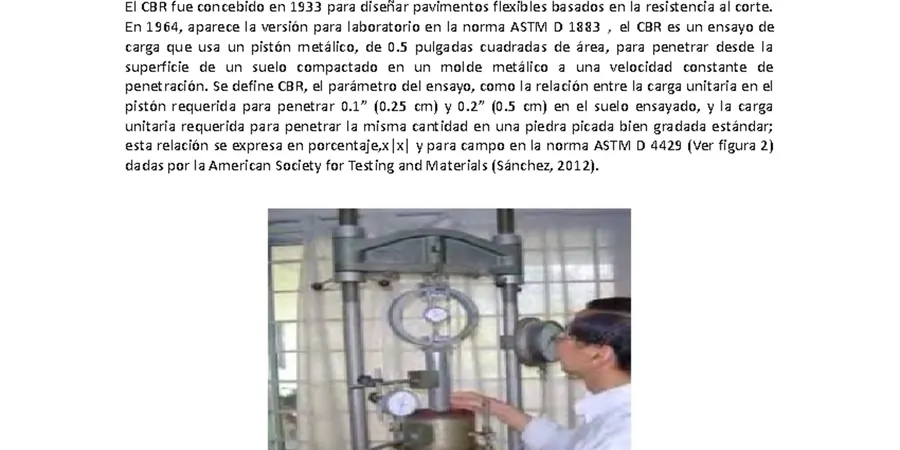
The loading press in our Overland Park lab runs a steady 0.05 inches per minute—exactly what ASTM D1883 calls for—and honestly, watching that piston push into a compacted clay sample tells you more about local subgrade than a dozen hand-auger logs. Overland Park sits on residuum from the Pennsylvanian-aged Kansas City Group, mostly lean clays and silty clays that soften fast when the water table rises after a wet spring. On projects along Metcalf Avenue or near the Blue River tributaries, we routinely prepare three-point compaction curves before the CBR penetration phase, because moisture sensitivity here is the real deal. When the pavement section calls for crushed stone base over a treated subgrade, the Proctor tests we run alongside the CBR give us the density benchmark that ties everything together, while the grain size analysis confirms whether the fines content will hold or pump under load. The test itself is straightforward—compact, soak for 96 hours if the design assumes worst-case moisture, then measure the resistance—but interpreting the 0.1-inch and 0.2-inch penetration values against a standard crushed-rock reference takes experience with Johnson County soils specifically.
A soaked CBR value under 3 on Johnson County lean clay means you are building on a sponge—moisture control during compaction becomes the single most cost-effective design decision.
Methodology and scope
Local considerations
One thing we keep seeing in Overland Park is CBR results that look fine on the report—six percent, eight percent—but the subgrade still pumps and rutts within two seasons. The culprit is almost always drainage. The Pennsylvanian shale and limestone residuum holds perched water in ways that a single soaked CBR test cannot capture, especially on sloping lots in southern Overland Park where groundwater migrates along weathered bedrock contacts. If the design assumes drained conditions but the pavement section traps moisture beneath an impermeable asphalt layer, the effective CBR drops well below the lab value. We flag this when the plasticity index exceeds 20 and the percent passing the No. 200 sieve stays above 75—classic CH material that swells and loses bearing capacity together. A thorough site investigation should pair the laboratory CBR with field density testing and, on larger commercial pads, a CPT test to map weak zones that the sampling interval might miss. Skipping the soaked CBR and relying on unsoaked values for design is the fastest way to a failed pavement section in this part of Johnson County.
Applicable standards
ASTM D1883-21 — California Bearing Ratio (CBR) of Laboratory-Compacted Soils, ASTM D1557-12e1 — Modified Proctor Compaction, AASHTO T 193 — CBR of Laboratory-Compacted Soils
Associated technical services
Soaked CBR with Moisture-Density Relationship
Three-point compaction curve plus 96-hour soaked CBR penetration on remolded specimens. We report both 0.1-inch and 0.2-inch values with stress-penetration curves and the corrected CBR at 95 percent of maximum dry density. Suited for flexible pavement design under AASHTO and local Johnson County standards.
Unsoaked CBR for Granular Base and Subbase
Immediate CBR testing without soaking, typical for crushed stone base courses and granular subbase materials. We run the penetration piston directly after compaction at optimum moisture, providing values for structural number calculations when drainage is assured by the pavement section geometry.
Typical parameters
Frequently asked questions
How much does a laboratory CBR test cost in Overland Park?
A single-point soaked CBR test with the companion moisture-density curve typically runs between US$130 and US$190, depending on whether we are testing one specimen or a full three-point family. If the project needs multiple CBR points across different soil types or compaction moisture targets, the price scales per specimen. We always include the stress-penetration plots and the corrected CBR calculation in the report at no additional charge.
What is the difference between soaked and unsoaked CBR, and which one does my Overland Park project need?
Soaked CBR simulates the worst-case moisture condition the subgrade will see over the pavement life—we submerge the compacted specimen for 96 hours before running the penetration test. Unsoaked CBR tests the material right after compaction, which is more representative of granular base layers that drain freely. For Overland Park clays, Johnson County plan reviewers almost always require the soaked value because our native soils retain moisture and soften seasonally. We usually recommend soaked CBR for subgrade and unsoaked CBR for imported base materials.
How long does a laboratory CBR test take from sample delivery to report?
A standard soaked CBR test requires four days of soaking plus about one day for compaction, setup, penetration, and data reduction. In practice, you should plan on five to seven working days from the time we receive the undisturbed tube samples or bulk bags. If the project is on a tight schedule, we can run the compaction curve and penetration phases in parallel for multiple specimens, but the 96-hour soak is fixed per ASTM D1883 and cannot be shortened without compromising the result.