Overland Park sits on residual silty clays and loess-derived soils that change behavior fast when moisture content shifts by just a couple of percentage points. We see it on nearly every commercial pad off College Boulevard: a fill that looks tight during placement but fails density testing two days later because the lab curve was run on material that didn't match what the scraper actually delivered. The Proctor isn't a paperwork exercise here—it's the single most referenced number on the compaction spec sheet. Running a grain size analysis early in the borrow source evaluation tells us whether we should be using standard or modified effort, and pairing the Proctor with Atterberg limits catches those fat clay pockets that can throw your optimum moisture reading off by 3% or more.
A one-point Proctor on mixed borrow can miss the true maximum dry density by 2 pcf—that's the difference between passing and failing a nuclear gauge test.
Methodology and scope
Local considerations
Johnson County inspection requirements under IBC Chapter 18 tie field density acceptance directly to the lab Proctor curve. When the curve is wrong—wrong soil, wrong effort, or a one-point run on material that needed a full family—the entire compaction QA/QC chain breaks. We've seen deep fill lifts on the I-435 corridor get rejected because the lab curve was developed from a sample taken at the top of the cut while the contractor was placing material from 8 feet deeper, where plasticity was 10 points higher. The fix isn't cheap: scarify, re-water, re-compact, and re-test, all while the schedule burns. Overland Park's freeze-thaw cycling through January and February also means any fill placed near optimum in November may sit saturated through winter and lose strength by spring if the Proctor target didn't account for post-compaction moisture equilibrium.
Applicable standards
ASTM D698-12 (Standard Proctor), ASTM D1557-12e1 (Modified Proctor), IBC 2018, Chapter 18 (Soils and Foundations)
Associated technical services
Standard Proctor (ASTM D698)
For light structural fill, landscape berms, and utility trench backfill where compaction equipment is smaller and spec requires 90–95% of standard maximum density.
Modified Proctor (ASTM D1557)
The default for building pads, pavement subgrade, and engineered fill under footings in Overland Park commercial construction, typically requiring 95% of modified maximum.
One-Point Proctor (Field Check)
Quick verification when borrow material changes mid-project. We run a single point against an existing family of curves to confirm the compaction target hasn't shifted.
Full Family of Curves
When the site has multiple cut zones or imported fill from different quarries, we develop separate curves for each material type to keep field density testing accurate across the entire site.
Typical parameters
Frequently asked questions
How much does a Proctor test cost in Overland Park?
A standard or modified Proctor test typically runs between US$110 and US$180 per curve, depending on whether it's a single point or a full five-point family. We always quote based on the number of distinct borrow sources on your project.
Which Proctor method does Johnson County require—standard or modified?
For building pads, structural fill, and pavement subgrade, the county and most Overland Park geotechnical reports specify modified Proctor per ASTM D1557. Standard Proctor is generally reserved for landscape fills and utility bedding where lower compaction effort is acceptable.
How long does it take to get Proctor results?
A full five-point curve with moisture content determinations typically takes 24 to 48 hours from sample delivery. We can often expedite a one-point check to same-day turnaround if the sample arrives before 10 a.m.
Can you run a Proctor on aggregate base material?
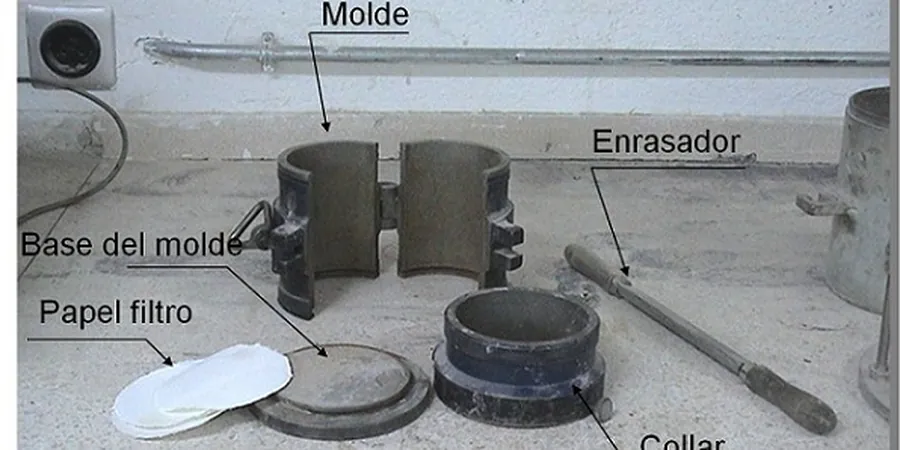
Yes, but the method changes. For material with more than 30% retained on the 3/4-inch sieve, we use the 6-inch mold and may apply a rock correction per ASTM D4718 to account for oversized particles that skew the density reading.
Why did my field density test fail when the lab Proctor curve looked fine?
The most common cause in Overland Park is a mismatch between the lab sample and the material actually being placed. Even a 4% difference in clay content shifts the curve noticeably. We recommend pulling a new bulk sample anytime the cut face changes color or texture.