The subgrade contrast between central Overland Park and the developing southern tracts near Blue Valley is often a matter of fill history versus residual limestone residuum. Where older commercial corridors sit on reworked silty clays, newer industrial pads south of 159th Street encounter loose to medium-dense sands that were placed without deep compaction. Our vibrocompaction design work starts by mapping those differences through CPT logs and grain-size curves, because a uniform grid assumption is what makes a design fail in Johnson County. For sites where sand layers grade into stiff clay, we combine the vibrocompaction program with a CPT test survey to confirm tip resistance after treatment and with grain-size analysis to verify that the soil matrix actually responds to vibratory energy.
Relative density targets above 70 percent in Overland Park sands require probe spacing calibrated to grain-size distribution, not copied from a standard chart.
Methodology and scope
Local considerations
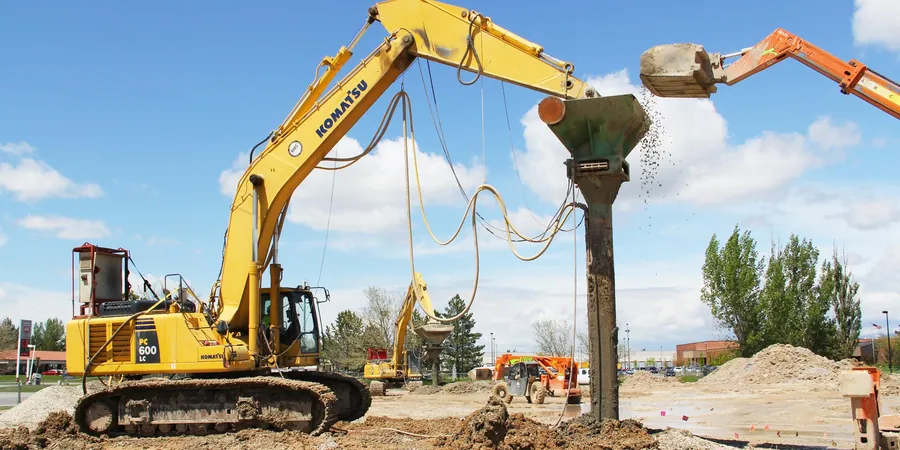
The vibrator itself is a long, cylindrical steel probe—typically 12 to 16 inches in diameter—equipped with an internal eccentric weight driven by a hydraulic or electric motor at the top. In Overland Park, where groundwater can sit within 15 feet of the surface in the alluvial plain east of US-69, the probe operates in a partially saturated zone that demands careful monitoring of amperage draw and penetration rate. If the crew pushes too fast through a silty lens, energy dissipates laterally instead of compacting the target stratum. Our design documents specify hold times and stepwise withdrawal increments tailored to the stratigraphy logged from the reference boring. We reinforce the design with liquefaction assessment checks where the water table and clean sand fractions create conditions comparable to the Midcontinent Rift sediments studied by the Kansas Geological Survey.
Explanatory video
Applicable standards
ASTM D4253 (Maximum Index Density), ASTM D4254 (Minimum Index Density), ASTM D6066 (Vibrocompaction Practice), FHWA-NHI-16-068 (Ground Improvement Design), ASCE 7-22 Chapter 20 (Site Classification)
Associated technical services
Pre-Treatment Site Characterization
We log reference borings and perform grain-size, Atterberg, and index density tests to determine whether the soil matrix is suitable for vibratory densification before any equipment is mobilized.
Trial Compaction and Grid Design
Using CPT and SPT baselines, we establish probe spacing, frequency, and duration through a trial section on site. The grid is then documented with station offsets and target depths for each point.
Real-Time Monitoring Protocol
We deliver a monitoring specification that defines amperage thresholds, penetration rate limits, and hold-time criteria per probe depth, keyed to the stratigraphy of the Overland Park site.
Post-Treatment Verification and Reporting
After compaction, we execute verification CPT or SPT soundings on a staggered grid and compare pre- and post-treatment logs. The final report includes statistical relative density plots and a signed compliance letter.
Typical parameters
Frequently asked questions
What soil types in Overland Park respond best to vibrocompaction?
Clean to slightly silty sands with less than 12–15 percent passing the No. 200 sieve respond efficiently. The alluvial terrace sands mapped along Indian Creek and the Blue River corridor are typically treatable. Soils with higher fines content or significant clay seams require a modified approach or a switch to stone columns.
How deep can vibrocompaction treat the loose fill common in southern Overland Park?
With standard vibrator setups we routinely reach 50 to 65 feet below working grade, which covers the depth of most engineered fills placed during commercial development south of 135th Street. Deeper natural deposits can be treated with extension leads if the rig has sufficient crowd force.
What does vibrocompaction design cost for a typical Overland Park commercial lot?
Design fees for a standard 2- to 5-acre commercial pad in Overland Park typically range from US$1,290 to US$5,620, depending on the number of reference borings, laboratory index testing required, and whether a trial compaction section is included in the scope.
How do you verify that the ground improvement actually worked?
We specify pre- and post-treatment CPT or SPT soundings on a staggered grid, comparing tip resistance or N-values at the same elevations. The acceptance criterion is typically a relative density of 70–85 percent, confirmed by correlation to the laboratory-measured minimum and maximum index density of the site sand.