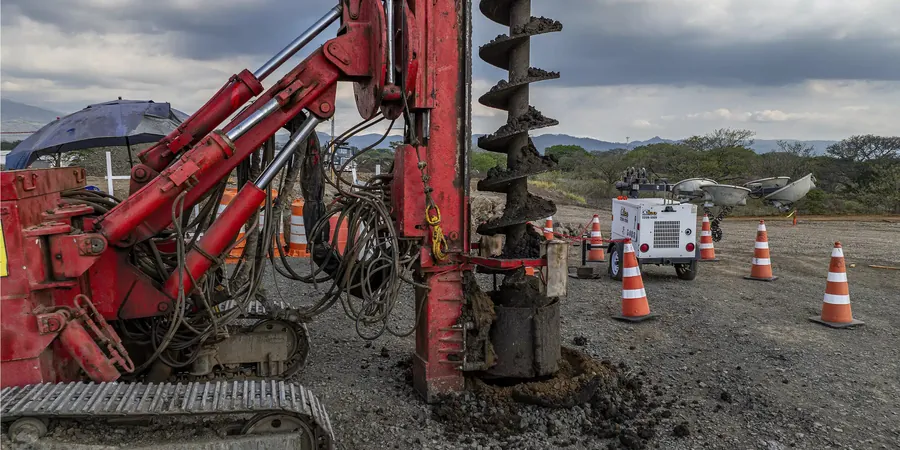
Overland Park sits on glacial till and loess-mantled uplands, but many commercial corridors follow old creek alignments where 15 to 30 feet of compressible alluvial clay lies directly beneath the pavement. We see it along Indian Creek and the Blue River tributaries. When a standard shallow footing hits that material, settlement estimates routinely exceed 2 inches under column loads. That is where stone column design changes the equation. Instead of deep piling, we install compacted gravel columns that reinforce the soft matrix and accelerate drainage. The concept is straightforward. You replace about a third of the weak soil volume with dense aggregate. The result is a composite mass stiff enough to support strip footings or floor slabs. In Johnson County, groundwater sits high in spring, so we combine the design with in-situ permeability testing to confirm radial drainage performance during construction.
A 30-inch stone column in Overland Park clay can cut settlement by half while doubling the bearing capacity of the treated footprint.
Methodology and scope
Local considerations
The mistake we see repeatedly is treating stone columns as a generic ground improvement item without adjusting the grid to the actual stratigraphy. A contractor orders a uniform 8-foot triangular pattern across a site where the clay thickness varies from 10 to 28 feet. The thin zones end up over-stiffened. The thick zones still settle 3 inches. Both outcomes create differential movement that cracks slab-on-grade floors within two seasons. In Overland Park, the alluvial clays along Turkey Creek have plasticity indices above 35. Those soils need closer spacing and a staged loading sequence to allow pore pressure dissipation. Skipping the CPT correlation before finalizing the grid is the single most expensive shortcut we encounter. Once the aggregate is in the ground, adjusting the layout is not practical. The fix usually costs more than the original installation.
Applicable standards
IBC Chapter 18 (Soils and Foundations), ASCE 7-22 (Minimum Design Loads), ASTM D448 (Aggregate gradation for construction), ASTM D3966 (Lateral load testing of deep foundations), FHWA-NHI-16-072 (Ground Improvement Methods)
Associated technical services
Settlement and bearing capacity analysis
We compute post-treatment settlement and allowable bearing pressure using the Priebe method, verified by axisymmetric FEM for complex layering or embankment loading.
Construction specification and QA/QC plan
We prepare the technical specification, aggregate gradation requirements, and the field verification protocol including multi-column load tests per ASTM D3966.
Subsurface investigation coordination
We scope and interpret CPT soundings and laboratory consolidation tests to define the compressible layer geometry before column layout.
Typical parameters
Frequently asked questions
How much does stone column design cost for a typical Overland Park project?
The engineering design package for a commercial or light industrial building in Johnson County generally runs from US$1,390 to US$5,860. The range depends on the treated area, number of column load tests, and whether we need to run finite element verification for irregular loading.
What soil conditions in Overland Park justify stone columns instead of deep foundations?
Stone columns work well in the soft alluvial clays and loose silts found along Indian Creek, Turkey Creek, and the Blue River tributaries. When the compressible layer is less than 35 feet thick and the undrained shear strength stays above 300 psf, stone columns tend to be more economical than driven piles. We verify with CPT data before recommending the approach.
How do you verify that the installed columns perform as designed?
We specify a multi-column load test per ASTM D3966, usually on a triangular group of three to five columns. The test applies 200 percent of the design load in increments. Settlement is monitored for at least 48 hours. We also run post-installation CPT soundings between columns to confirm the composite improvement ratio.
Does the Kansas frost depth affect stone column performance?
The 30-inch frost line in northeast Kansas does not damage stone columns the way it can crack shallow concrete. The open-graded aggregate drains freely and does not retain water that would freeze and heave. We still detail a granular cap and vapor barrier to protect the floor slab above, but the columns themselves are frost-stable by design.