A borehole rig fitted with HQ3 wireline coring equipment and a CPTu truck with a 20-ton hydraulic push system are often the first pieces of machinery deployed on an Overland Park site with significant relief. The city's terrain transitions from the broad, flat uplands of the Osage Plains into the deeply incised valleys of the Blue River and Indian Creek tributaries, exposing complex stratigraphy that demands precise characterization before any slope stability work begins. In the vicinity of Corporate Woods or south toward Blue Valley, we consistently encounter the Farley Limestone member interbedded with thin, slickensided shale partings that control failure geometry, while the upper 10 to 25 feet consist of variable Peoria Loess deposits that stand near-vertical when dry but lose cohesion rapidly after prolonged rainfall. Because the Missouri-Kansas state line cuts through a region with known paleolandslide features along the Blue River bluffs, our investigations routinely include oriented Shelby tube sampling and downhole inclinometer arrays to detect pre-failure creep before it becomes visible at the surface. This layered approach, combining deep rotational analysis of the bedrock contact with infinite-slope modeling of the colluvial veneer, forms the backbone of every slope stability assessment we produce for Johnson County permitting submissions.
In Overland Park, the critical failure surface is rarely in the limestone itself — it propagates along the clay-filled shale seams where residual friction angles drop to 12-16 degrees.
Methodology and scope
Local considerations
ASCE 7-22 Section 11.8.3 requires explicit slope stability evaluation for structures assigned to Seismic Design Category C or higher within 50 feet of a slope crest steeper than 1:3 (horizontal:vertical), a condition that applies to numerous properties along the Blue River escarpment in eastern Overland Park. The seismic hazard here is moderate — the 2023 USGS NSHM maps assign a short-period spectral acceleration SDS of approximately 0.30g for Site Class C locations — but the combination of cyclic degradation in saturated loess and the kinematic amplification that occurs at slope crests means that a pseudostatic analysis using a horizontal coefficient of 0.12g can reduce the static factor of safety by 30 to 40 percent on a 2H:1V slope underlain by shale. Far more frequent, however, is the risk associated with prolonged wet cycles: Overland Park receives an average of 40 inches of precipitation annually, concentrated in spring and early summer, and the antecedent moisture condition in the upper 6 feet of the loess mantle frequently reaches field capacity by late May. This saturation front triggers shallow translational slides in the colluvial wedge, particularly where downspout discharge or irrigation overspray adds concentrated flow at the crest. Our analyses incorporate both steady-state and transient seepage scenarios calibrated to Johnson County's 100-year storm depth of 7.8 inches in 24 hours, and we specify the drainage measures — typically trench drains or horizontal wick drains — required to maintain the design factor of safety throughout the design life of the improvement.
Explanatory video
Applicable standards
ASCE 7-22 Chapter 11 (Seismic Design Criteria, Section 11.8.3 Geologic Hazards), IBC 2021 Section 1803.5.11 (Slope Stability Analysis Requirements), FHWA-NHI-05-123 (Soil Slope and Embankment Design, Reference Manual for Limit-Equilibrium Methods), ASTM D1586-18 (Standard Penetration Test, for shear strength correlation in shale), ASTM D6467-21 (Torsional Ring Shear Test, for residual friction angle of shale seams), USACE EM 1110-2-1902 (Slope Stability, Corps of Engineers Manual for Spencer and Morgenstern-Price methods)
Associated technical services
Limit-Equilibrium Modeling with Local Stratigraphy
We build 2D models in Slide2 and SLOPE/W incorporating the specific Farley-Westerville limestone sequence, shale partings, and Peoria Loess thickness mapped from geotechnical borings across the site, using back-analyzed shear strengths from existing cuts along I-435 and Nall Avenue corridors.
Seismic Pseudostatic and Deformation Analysis
For sites within the IBC slope proximity zone, we perform both pseudostatic limit-equilibrium runs and Newmark-type sliding block displacement analyses using the USGS deaggregated magnitude-distance pair for Overland Park (approximately Mw 6.8 at 80 km from the Nemaha Ridge source).
Remediation Design and Drainage Specification
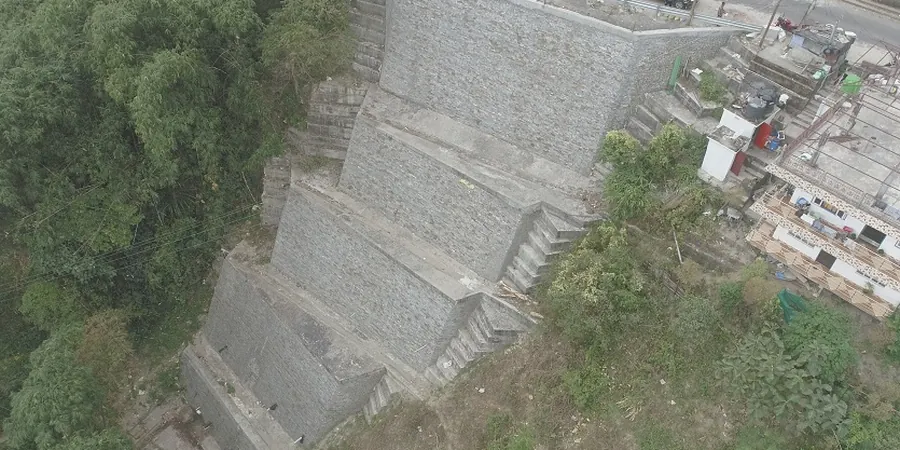
Where existing slopes exhibit incipient movement — evidenced by tension cracks or tilted fence posts along the crest — we design anchored soldier pile walls, shear keys, or soil nailing arrays, paired with subhorizontal drains and surface water diversion swales sized for the Johnson County 100-year event.
Typical parameters
Frequently asked questions
How much does a slope stability analysis cost for a single-family lot in Overland Park?
For a typical residential lot with a 15- to 25-foot cut or fill slope in Johnson County, the combined field investigation and limit-equilibrium analysis report generally ranges from US$1,430 to US$4,040, depending on the number of borings required, whether laboratory residual shear testing on shale is necessary, and the level of detail the city's grading plan reviewer requests.
What triggers a slope stability analysis requirement under Overland Park's adopted IBC?
The 2021 IBC as enforced by Overland Park's Building Safety Division requires a geotechnical slope stability report when a proposed structure is within a horizontal distance equal to the slope height from the crest of a slope steeper than 1:3, or when the slope height exceeds 10 feet and the structure will impose a surcharge load within the potential failure zone. The report must demonstrate a minimum static factor of safety of 1.5 for permanent conditions and address seismic stability per ASCE 7-22 where Site Class C applies.
How long does the analysis process take from field work to final report?
Field drilling and sampling typically require 2 to 4 days on site, followed by 2 to 3 weeks for laboratory testing including triaxial shear and ring shear on shale samples. The limit-equilibrium modeling and report preparation add another 1 to 2 weeks, so a complete deliverable generally takes 4 to 6 weeks from mobilization, though we can provide preliminary setback recommendations within 10 business days for urgent permitting deadlines.