Compaction verification in Overland Park demands strict adherence to ASTM D1556 and D6938, particularly given the prevalence of expansive clay and residual shale formations across Johnson County. The sand cone method remains the definitive field check for earthwork, utility trenches, and commercial pad construction. Our lab runs these tests daily on sites from College Boulevard to Blue Valley, delivering dry density and moisture content data within 24 hours. For engineered fill placed over Pennsylvanian-age bedrock, we often pair sand cone readings with Proctor tests to establish the compaction curve baseline, ensuring the field density meets the 95% standard specified in project geotechnical reports. Overland Park's municipal inspectors and private engineers rely on this direct-volume method because it eliminates the calibration drift common in nuclear gauges on shale-rich fills.
A sand cone test in Overland Park clay gives you one number. That number tells you whether the roller needs another pass or the lift needs to be ripped out.
Methodology and scope
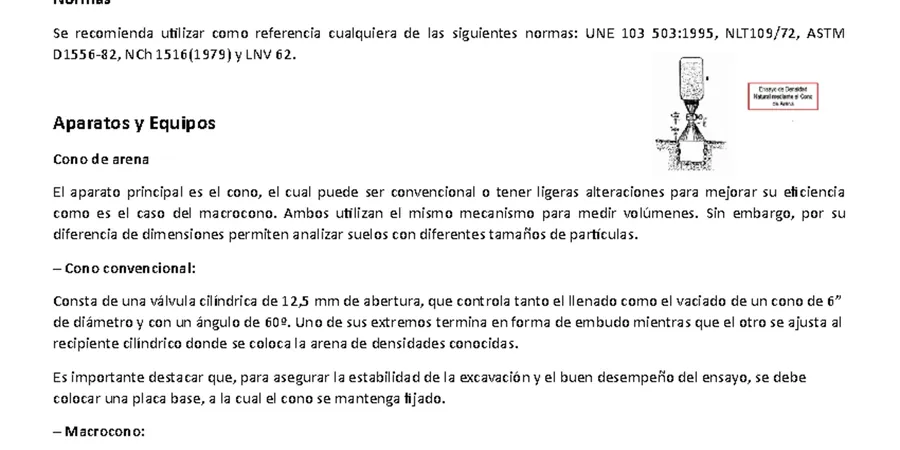
Local considerations
Sites in northern Overland Park near I-35 often encounter loess-derived silts that compact easily but lose strength when saturated. In contrast, the residual shale fills common south of 159th Street tend to degrade into slabby fragments that resist standard compaction, creating void spaces that a sand cone test can miss if the hole is too shallow. The biggest risk is a false passing result on a fill that will settle unevenly after the first heavy rain. We address this by excavating deeper test holes in shale fills and screening the extracted material to check for oversized particles. Skipping a density check on a utility trench backfill in an expansive clay zone can lead to differential heave that cracks pavement within two seasonal cycles.
Applicable standards
ASTM D1556: Standard Test Method for Density and Unit Weight of Soil in Place by Sand-Cone Method, ASTM D2216: Standard Test Methods for Laboratory Determination of Water (Moisture) Content of Soil and Rock, ASTM C778: Standard Specification for Standard Sand, ASTM D698: Standard Test Methods for Laboratory Compaction Characteristics of Soil Using Standard Effort, AASHTO T-191: Density of Soil In-Place by the Sand-Cone Method
Associated technical services
In-Place Sand Cone Density
Standard ASTM D1556 test on compacted fill, subgrade, and trench backfill. Includes dry density, wet density, and percent compaction relative to lab Proctor.
One-Point Proctor Correlation
Rapid field Proctor check using a single-point method to verify that the moisture-density curve used for acceptance still represents the material being placed.
Utility Trench Verification
Density testing at specified intervals along water, sewer, and storm drain trenches, with documentation formatted for municipal acceptance in Overland Park.
Nuclear Gauge Correlation
Side-by-side sand cone and nuclear gauge tests to develop site-specific calibration curves when a nuclear gauge is approved for production testing on large pads.
Typical parameters
Frequently asked questions
How much does a sand cone field density test cost in Overland Park?
A single sand cone test on a residential or commercial site in Overland Park runs between US$110 and US$150, depending on travel distance and the number of tests scheduled for the same day.
How deep should the test hole be for ASTM D1556?
ASTM D1556 requires the test hole volume to be at least 12 times the maximum particle size. In Overland Park shale fills with 3-inch fragments, we excavate holes roughly 6 inches deep and 6 inches in diameter to meet this minimum volume criterion.
When does Overland Park require sand cone testing instead of a nuclear gauge?
City inspectors often mandate sand cone tests when the fill contains shale, chert, or other materials that affect nuclear gauge readings. The method is also required for proof-rolling acceptance and conflict-resolution testing when compaction results are in dispute.
How long does it take to get results from a field density test?
We provide verbal results on-site immediately after weighing and moisture correction. A signed PDF report with GPS coordinates, test location sketch, and percent compaction values is emailed the same day, typically within 4 to 6 hours.